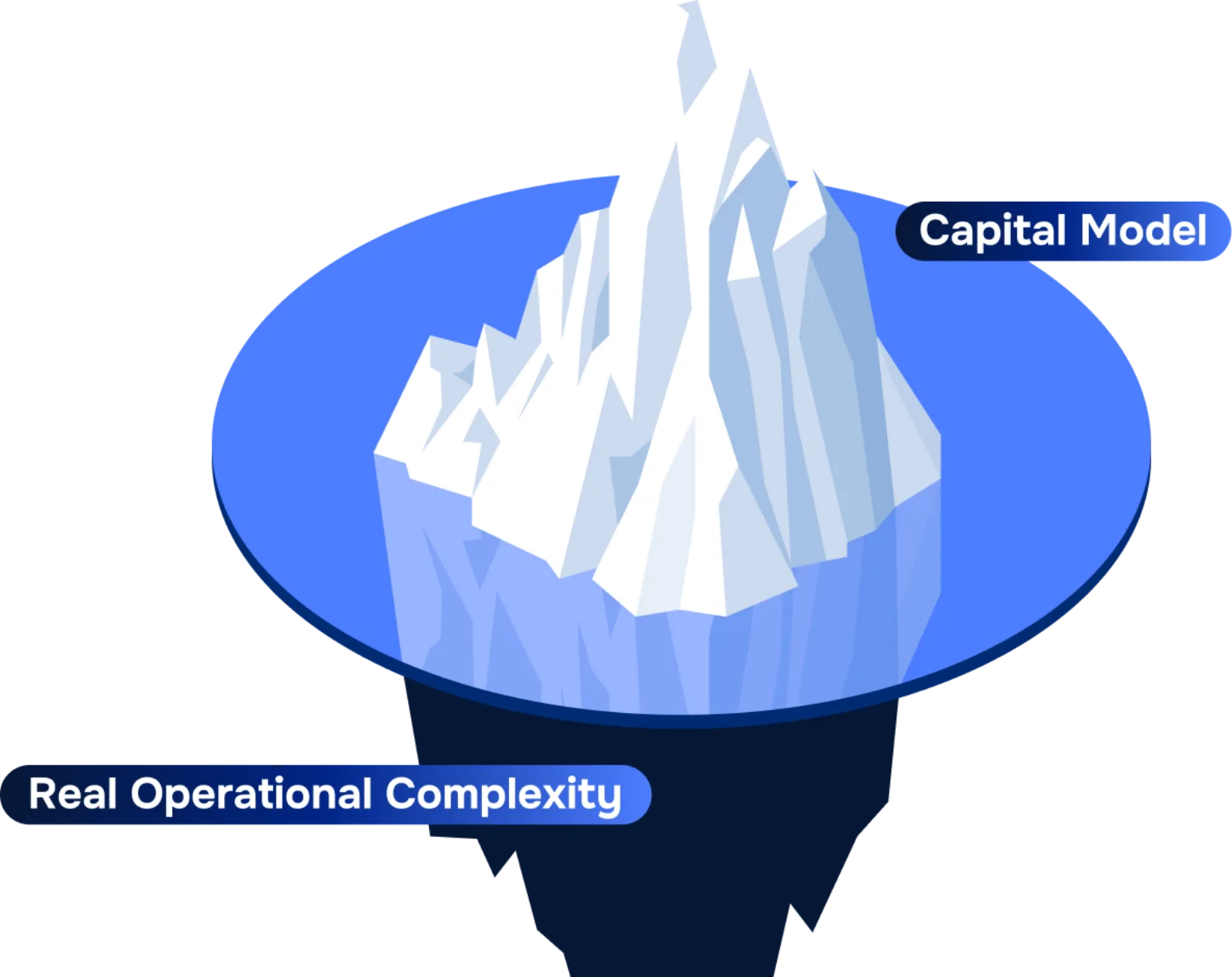
UK specialist construction lenders are now fielding AI pitches at a rate that makes proper evaluation difficult. Document intelligence vendors, agentic workflow vendors, conversational interface vendors, and the broader "AI for lending" category all pitch into the same buyer with claims that often blur together. The result: a Head of Credit comes out of a vendor cycle with five demos, three different vocabularies for the same thing, and no clear model for what AI can and cannot do legitimately in a UK regulated environment.
This piece sets out a working model. Three layers of AI capability, what each can and cannot do, how the UK regulatory backdrop shapes adoption at each layer, and a practical framework for evaluating vendor claims.
AI in UK construction lending: what works and what does not
AI in lending breaks down into three layers worth keeping distinct. They sit at different stages of maturity, carry different regulatory weight, and demand different governance. Treating them as a continuum that any AI tool slides along is the mistake UK lenders most often make in vendor evaluation. The risk, governance, and value propositions are structurally different.
- Layer 1 is document intelligence. Reading documents and turning them into structured data the credit team can use. Mature, low-risk, and widely deployed across UK specialist lending today.
- Layer 2 is conversational intelligence. AI that lets a credit officer query the lender's own data and documents in natural language and get useful answers back. Reaching mainstream maturity in 2026. Defensible as a co-pilot. Riskier as a self-service tool for external users.
- Layer 3 is agentic intelligence. AI that takes actions, executes workflows, or makes decisions with limited human oversight. This is where most vendor claims outrun reality, particularly in UK regulated lending where auditability and human accountability are non-negotiable.
Layer 1: Document intelligence (the easy and proven layer)
Layer 1 is reading. The AI takes a document — invoice schedule, cost report, building contract, planning condition, insurance certificate — and extracts the relevant structured information. The credit team gets clean data they would otherwise have to read and re-key manually.
The mature uses in UK specialist construction lending: monitoring surveyor cost report parsing, invoice schedule extraction and reconciliation, conditions precedent tracking against the facility agreement, ID and AML document validation, and project-level document ingestion at facility origination.
The reason Layer 1 is low-risk is that the AI surfaces what the document already says. The credit officer still validates, still applies judgement, still owns the decision. The AI compresses the assembly step, which is where most of the elapsed time on a UK drawdown goes.
A lender's Layer 1 evaluation is straightforward. How accurate is extraction across the document types the lender actually receives. How does the system handle edge cases (handwritten amendments, scanned PDFs, missing pages). What's the audit trail when the AI gets something wrong. How does the system flag low-confidence outputs for human review.
Layer 1 is where most of the demonstrable value in UK lending AI sits today. The adoption case is conservative and immediate: deploy it, capture the operational gain, build internal AI governance muscle on a low-risk surface.
Layer 2: Conversational intelligence (chatbot vs co-pilot)
Layer 2 is asking. A credit officer types "show me all facilities where retention reconciliation has drifted above £500" or "which facilities have outstanding collateral warranty gaps this month" and gets a structured answer back, derived from the lender's own data.
This is the layer moving fastest in 2026. The capability has reached the point where a well-designed conversational interface meaningfully improves credit-officer productivity, particularly on portfolio-wide queries that would otherwise require pulling data from multiple systems.
The defensible use case for UK specialist lenders is credit-officer co-pilot. The AI surfaces information from documents and data the lender already holds, and the officer acts on it. A chatbot embedded in the credit team's working environment that can answer "what's the contingency position across all my Manchester facilities" is genuinely useful.
A chatbot that customer-facing developers could query directly carries conduct and consumer-duty considerations of a different order, and few UK specialist lenders are yet putting AI on that surface for good reason.
The boundary that matters: Layer 2 surfaces and synthesises, but doesn't take action. The officer reading the AI's answer still makes the call.
Layer 3: Agentic intelligence (the layer most vendors are overselling)
Layer 3 is doing. The AI doesn't surface information for a human to act on; the AI takes the action. Vendor pitches: AI approves drawdown applications, AI generates monitoring surveyor sign-offs, AI underwrites new facilities, AI triggers covenant breaches and initiates workouts.
This is where the gap between demo and production reality is widest. The honest position in UK specialist lending in 2026 is that genuine agentic AI — taking regulatory-significance actions without meaningful human oversight — is rare in deployment and rarer in audit-defensible form.
The reason is structural. A drawdown approval is a regulated decision. The credit officer signing it owns it under their Senior Management Function or equivalent accountability. If the decision was actually made by an AI system, the question of who owns it gets uncomfortable quickly. The audit trail has to show that a human exercised meaningful oversight, not that a human rubber-stamped an AI output.
What vendors often call "agentic" is Layer 2 with workflow automation. The AI surfaces a recommendation, structures the action, and presents it to a human who clicks approve. That's automation around a Layer 2 capability, which is fine, but should be evaluated as Layer 2.
Operational decisions of low regulatory weight: routing documents to the right reviewer, scheduling site visits, sending reminders, archiving completed records. Operational housekeeping. The credit decisioning stays with the credit team.
How the UK regulatory backdrop shapes what is allowed at each layer
Three UK regulatory references shape what AI can legitimately do at each layer.
The PRA's Supervisory Statement SS1/23 ("Model risk management principles for banks", May 2023) sets five principles of model risk management: model identification and classification, governance, model development and use, independent validation, and model risk mitigants. SS1/23 formally applies to PRA-regulated banks with internal model approval. Most UK specialist development lenders are not in that scope. But the principles are setting the market standard, and specialist lenders looking to upgrade AI governance are working from SS1/23 as the most relevant UK reference even where it doesn't bind directly.
The joint Bank of England, PRA, and FCA Discussion Paper DP5/22 ("Artificial Intelligence and Machine Learning", October 2022), together with its 2023 feedback statement (FS2/23 / FS23/6), sets out the regulators' direction of travel. DP5/22 isn't binding policy. But it tells UK lenders what the supervisory authorities are likely to want to see in AI governance frameworks as adoption deepens.
The RICS AI Professional Statement (mandatory from 9 March 2026) governs the monitoring surveyors and QS firms on lender panels. Every AI-assisted output in an MS cost report now carries a reliability decision and audit trail. The lender's AI overlay isn't only about the lender's own systems. It extends to the panel firms whose AI-assisted outputs the lender receives and relies on.
The combined effect: Layer 1 sits comfortably with the regulatory backdrop given proportionate governance. Layer 2 sits comfortably as a co-pilot and more cautiously as a customer-facing surface. Layer 3 carries an oversight burden high enough that most vendor claims fail the test.
How a UK Head of Credit should evaluate AI claims from vendors
A practical evaluation framework, layer by layer.
- Classify which layer the vendor is really at. Vendor language is unreliable — most "agentic" tools are Layer 2 with workflow automation, most "AI-powered" tools are Layer 1 with a chat interface. The substantive question: when the AI produces an output, what happens? If a human reviews and decides, it's Layer 2. If the system takes the action, it's Layer 3.
- Ask where the audit trail lives. For any output a regulator, auditor, or institutional funder will eventually ask about, the audit trail needs to capture the input the AI received, the output it produced, the reliability indicator it carried, and the human review that took place.
- Ask how reliability decisions are handled. RICS now requires that any AI-assisted output in a panel firm's report carries a reliability decision from the responsible surveyor. The lender's own AI use needs the equivalent discipline: a human-attributed decision on whether to rely on a given AI output.
- Ask about contractual position on AI-driven errors. If the AI gets a calculation wrong and the lender approves a drawdown that shouldn't have approved, who carries that risk? Vendor terms vary widely. The default tends to favour the vendor in ways UK specialist lenders should push back on at procurement.
Where BankBuild sits across the three layers
Across the three layers, BankBuild's deployment is deliberately conservative.
At Layer 1, document intelligence sits at the core of the platform. Cost report parsing, invoice extraction, conditions precedent tracking, retention reconciliation. The credit team gets structured data they would otherwise be re-keying from PDFs.
At Layer 2, the BankBuild Assistant operates as a co-pilot across the lender, monitoring surveyor, and developer surfaces. Each user's view is gated to the data they have legitimate access to. The Assistant surfaces information; the human acts. No customer-facing chatbot for unauthenticated users.
At Layer 3, BankBuild does not position itself as an agentic platform. The credit decision belongs to the credit officer. The monitoring surveyor's sign-off belongs to the surveyor. The audit trail is generated as a function of the work, with every AI-assisted output carrying a human-attributed reliability decision in line with the RICS AI Professional Statement.
The positioning is deliberate. A platform built into the UK specialist lending stack at this point in the regulatory cycle should be over-engineered for auditability and under-promising on autonomy. The framework will move as the regulatory environment matures.
For the regulatory backdrop in full, see the UK regulatory framework for construction lending.
Frequently asked questions
-
Document intelligence reads documents and produces structured data. Conversational AI lets a user query data and documents in natural language. Agentic AI takes actions or makes decisions with limited human oversight. The three layers carry different risk, governance, and regulatory weight, and a vendor's claim to be "agentic" often describes Layer 2 with workflow automation around it.
-
The RICS AI Professional Statement (mandatory from 9 March 2026) requires that any AI-assisted output in a chartered surveyor's report carries a reliability decision and audit trail. For a lender receiving an MS cost report, the practical implication is that the cost report itself now carries an AI-compliance overlay. The lender's panel onboarding and ongoing oversight of MS firms needs to evidence that the firm's AI use is RICS-compliant.
-
Not in a regulator-defensible way at the level of an individual credit decision. The drawdown approval is a regulated decision that belongs to a named human under their accountability framework. AI can compress the assembly work that goes into the decision and can surface exceptions for human review. The decision itself stays with the credit officer.
-
Classify the vendor's actual capability layer (vendor language is unreliable). Verify the audit trail captures input, output, reliability indicator, and human review. Confirm reliability decisions are human-attributed where panel firms are involved. Check contractual allocation of risk for AI-driven errors.